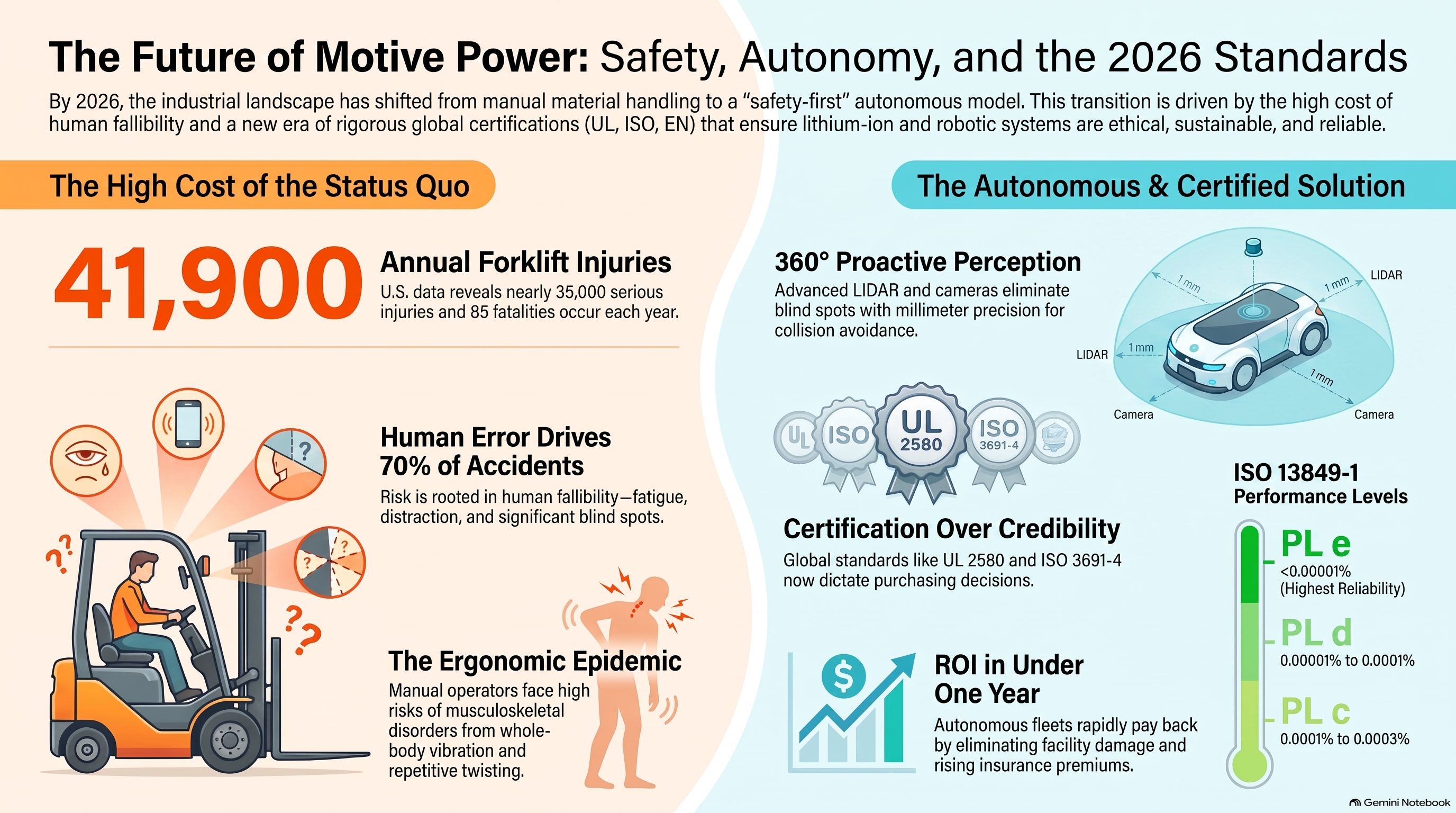
The same autonomous forklift, built to the same safety architecture, faces two entirely different doors depending on which side of the Atlantic it ships to. In the EU, a machine must prove it is safe before it enters the market. In the US, a machine is presumed safe until something goes wrong — and then the manufacturer must prove it was safe all along.
That single asymmetry explains almost everything else. It is the difference between a preventive, harmonized regime and a decentralized, liability-driven one.
The philosophical split
The two systems disagree on a foundational question: who carries the burden of proof, and when?
| European Union | United States | |
|---|---|---|
| Legal basis | Machinery Regulation (EU) 2023/1230 — directly applicable | OSHA Act, General Duty Clause, 29 CFR 1910 |
| Model | Preventive, pre-market | Reactive, post-market liability |
| Who is regulated | The manufacturer, before sale | The employer, after deployment |
| Core mechanism | CE marking + Declaration of Conformity | OSHA citations + product-liability lawsuits |
| Enforcement | Market surveillance, Notified Bodies | NRTL listing, AHJ field inspection |
The EU gives you a gate you must pass through. The US gives you a liability landscape you must navigate yourself. Neither is obviously lighter — they just demand different kinds of diligence.
Conformity assessment: a mark vs a listing
The EU's conformity assessment is a ladder. For machinery that follows harmonized standards, the manufacturer self-declares (Module A) — compile the risk assessment, write the technical file, affix the CE mark. But if the vehicle's safety path uses self-evolving machine learning, it climbs to Annex I Part A, and a Notified Body becomes mandatory.
The US has no direct equivalent. There is no single authority that stamps approval on an autonomous forklift. What exists instead is the NRTL listing — third-party testing by a Nationally Recognized Testing Laboratory (UL, ETL, TÜV SÜD America) against standards like UL 583 for electric battery-powered trucks and UL 3100 for automated mobile platforms.
A nuance that trips up a lot of teams: UL 3100's scope explicitly excludes vehicles with forks — it does not cover lifting tines. An autonomous forklift is evaluated under UL 583, not UL 3100.
Functional safety: same math, different container
Here is the counterintuitive part. The US does not have its own functional-safety mathematics. When an American engineer computes a Performance Level or a SIL, they use the same IEC 61508 / IEC 62061 / ISO 13849 framework as their European counterpart.
The difference is the wrapper:
| EU | US | |
|---|---|---|
| Machine-level standard | ISO 3691-4 (driverless trucks) | ANSI/RIA R15.08 (IMRs), ANSI/ITSDF B56.5 (AGVs) |
| Functional-safety math | ISO 13849-1 (PL), IEC 62061 (SIL) | Same standards, referenced |
| Vehicle classification | Zone-based (operating/hazard/restricted/confined) | Type A/B/C (platform → payload → arm) |
The EU's ISO 3691-4 explicitly maps required Performance Levels to each safety function, removing ambiguity. The US's R15.08 introduces its own typology — Type A (standalone platform), Type B (platform + payload), Type C (platform + robot arm) — where a Type C vehicle's arm falls back to R15.06 and PL d Category 3.
The electrical minefield: color codes and pilot lights
The most concrete day-to-day difference is in the wiring — partly the standards themselves, partly the legacy panel practice each region's technicians grew up with:
| Convention | EU (IEC 60204-1) | US (NFPA 79) |
|---|---|---|
| Neutral conductor | Light blue | White or natural gray |
| DC control circuit | Blue | Blue |
| Green indicator | "Safe / de-energized" | "Running / energized" (legacy panel practice; current NFPA 79 indicator semantics largely mirror IEC) |
| Red indicator | "Danger / energized" | "Stopped / e-stopped" (same caveat) |
The indicator-light conflict is the most dangerous. In legacy practice, a green light means "de-energized and safe" in Europe and "running and energized" in the US. A European-wired vehicle deployed in a US facility without modification can signal the exact opposite of what an operator expects. The practical workaround that global manufacturers converge on: text-labeled digital HMIs instead of colored pilot lights.
Cost and timeline
The economics diverge sharply, and the divergence is driven by when third-party involvement becomes mandatory. (The figures below are typical ranges; they vary with the Notified Body or NRTL and the scope of the assessment.)
| Parameter | EU — self-certify (Module A) | EU — Notified Body (Annex I Part A) | US — NRTL listing |
|---|---|---|---|
| Upfront cost | €5k–€15k | €50k–€100k+ | $33k–$65k (base), $100k+ (full system) |
| Annual maintenance | €1k–€5k | €2k–€10k | $2k–$5k |
| Timeline | 8–16 weeks | 12+ months | 16–24 weeks |
The striking result: the EU is the cheaper, faster market for a deterministic vehicle (self-certification costs a fraction of an NRTL listing), but the most expensive path of all is an AI-heavy EU vehicle forced through the Notified Body track. The US cost is roughly constant regardless of autonomy level — because the NRTL listing is driven by the electrical/fire/battery testing, not the navigation logic.
The market-entry decision
This cost structure produces a clean strategic fork:
flowchart TD
    A{"Vehicle autonomy level?"} -->|"High AI / self-evolving"| B["Europe first"]
    A -->|"Deterministic / standard"| C["US first"]
    B --> D["Design to ISO 3691-4<br/>Prepare for Notified Body"]
    C --> E["Leverage self-validation<br/>Rapid revenue pilots + field labels"]
- High-AI vehicles → Europe first. The EU's strict upfront requirements force a clean functional-safety and cybersecurity architecture from day one, and a vehicle certified to ISO 3691-4 with PL d transfers to the US with minimal rework.
- Deterministic AGVs → US first. Self-validation under B56.5/R15.08 means a vehicle can deploy on a US floor — with Field Evaluations running in parallel — and start generating revenue before the full NRTL listing completes.
The recommended endgame for most serious manufacturers is joint engineering: design the physical safety to ISO 3691-4 (PL d scanning), build the electrical cabinet from dual-certified (UL-listed and CE-marked) components with modular wiring, and use text-labeled digital HMIs to sidestep the color-code conflict entirely.
The honest summary
Neither system is "the hard one." They are hard in different places:
- The EU is hard up front. A clear gate, a harmonized standard, a single mark — but if your autonomy is AI-driven, that gate is guarded by a Notified Body and a 12-month review of your learning algorithm.
- The US is hard in the aftermath. No single gate to pass, but a liability landscape where the adequacy of your risk assessment is tested only after an incident — by an OSHA citation or a plaintiff's attorney.
The engineering lesson that carries across both: risk assessment first, autonomy stack second. The zones, the speed limits, the PL targets, and the hardware choices all flow from the risk assessment — whether that work is later checked by a Notified Body in Brussels or a courtroom in Texas.
This is Part 3 of a three-part series. Part 1 — Germany/EU and Part 2 — United States cover each regime in depth. This comparison draws on the Machinery Regulation (EU) 2023/1230, ISO 3691-4, ISO 13849-1, ANSI/ITSDF B56.5, ANSI/RIA R15.08, OSHA 1910.178, NFPA 79, and the UL 583 / UL 3100 listing requirements.